Sunday, 21 April 2013

Japonisme 

Japonisme/Japonism is a french term that refers to the influence of Japanese art on Western art. In 1853/1854 Japan had re-opened their ports to trade with the western world. A tidal wave of foreign imports flooded Europe, the imports consisted of fans, porcelains, woodcuts, kimonos, lacquers, wood block prints, bronzes and silks. In 1862 the World Fair hosted in Europe brought even more attention to Japanese Art. In the 1860's Japanese wood block prints became very popular and were a source of inspiration to many impressionist and post-impressionist artists in the west such as Monet, Van Gogh and Paul Gauguin. Western artists were fascinated by the Japaneses decorative arts because it offered a new freedom from imitative or photographic representation, and introduced new angles of vision and an entirely different treatment of perspective.  The aesthetics and characteristics that are noticeable in Japanese art are elongated pictorial formats, asymmetrical compositions, aerial perspective, spaces emptied of all but abstract elements of colour and line, a focus on singularly decorative motifs, cropped close-up partial views of objects in the foreground and the use of bold, unshaded colour. Quite a few well known western painters in that time show characteristics of Japanese art in their paintings such as Van Gogh, Toulouse Lautrec etc.  

An example of an artist that showed Japanese influences in his paintings is Henri Toulouse Lautrec. 


The dance hall named Moulin Rouge had made a competition and chose Henri Toulouse-Lautrec's poster design. The appearance of the poster Moulin Rouge: La Galoue on the Parisian streets made him famous over night and launched his artistic career. The poster above shows Japanese characteristics because of its bold colours and abstract lines and flatness.

VGG, 2013. Van Gogh Gallery. [Online] Available at <http://www.vangoghgallery.com/influences/japonisme.html>
[Accessed on 21st April 2013]

TBH, 2013. The British Museum. [Online] Available at <http://www.britishmuseum.org/explore/highlights/articles/j/japonisme.aspx>
[Accessed on 21st April 2013]

TMMA, 2013. The metropolitan museum of art. [Online] Available at <http://www.metmuseum.org/toah/hd/jpon/hd_jpon.htm>
[Accessed on 21st April 2013]

NGA, 2013. The national gallery of Australia. [Online] Available at <http://artsearch.nga.gov.au/Detail.cfm?IRN=200125>
[Accessed on 21st April 2013]


Saturday, 20 April 2013

The Great Exhibition 

The Great Exhibition was an idea dreamt up by Queen Victoria's husband, Prince Albert, to display the wonders of industry and manufacturing from around the modern world a. The Great Exhibition was held in the Crystal Palace which was situated in Hyde Park in London and was opened on the 1st of May to the 15th of October. The Crystal palace was made of glass and iron columns.The Great Exhibition was the first international exhibition of manufactured products and was enormously influential on the development of many aspects of society including art and design education, international trade and relations, and even tourism. There were over 13,000 exhibits that were displayed from all around the world with some 100,000 objects displayed among more then ten miles and had over 15,000 contributors to the exhibition. Britain who was hosting the exhibition occupied half of the display space available inside the Crystal Palace. The exhibits consisted of a massive hydraulic press, a steam-hammer, adding machines, defensive umbrellas, A printing machine that could churn out 5,000 copies of the popular newspaper of the time Illustrated London News in an hour, carriages and saddlery, sculptures and furniture, fantastic jewels and diamonds. By the time The Great Exhibition had closed over six million people had visited the exhibitions.


[Accessed 20th April 2013]

V&A, 2013. Victoria and Albert Museum. [Online] Available at <http://www.vam.ac.uk/content/articles/t/the-great-exhibition/>
[Accessed 20th April 2013]

VS, 2013. Victoria Station. [Online] Available at <http://www.victorianstation.com/palace.html>
[Accessed 20th April 2013]


Neoclassicism 

Neoclassicism was the movement that began in the late 18th century and early 19th century. It was a desire to rekindle the spirit and forms of classical art from ancient Greece and Rome. Neoclassicism was a reaction against Baroque and Rococo style that had dominated European Art during the early 18th Century. Neoclassical works were serious, unemotional and heroic. The paintings generally depicted subjects from classical literature and history using archaeologically correct settings and costumes. They used sombre  shadows with occasional brilliant highlights to communicate the moral narratives of self-denial and self sacrifice.  

An example of a neoclassical painter was Jean-Auguste-Dominique Ingres. 

The Apotheosis of Homer, 1827

The Apotheosis of Homer is an oil painting that measures 13x17 Feet.  It was commissioned in 1826 as a ceiling decoration for the Louvre and was completed and exhibited in 1827. The painting is symbolic of Ingres's  belief in a hierarchy of timeless values that were based on classical precedent.  

Impressionist, 2013. [Online] Available at: <http://impressionist1877.tripod.com/neoclassicism.htm>
[Accessed 20th April 2013]

Visual Arts, 2013, History of Art. [Online] Available at: <http://www.visual-arts-cork.com/history-of-art/neo-classical.htm#definition
[Accessed 20th April 2013]

Pop Art


Pop Art was a movement that was born in Britain in the 1950's. It was the creation of several artists who named themselves The Independent Group. They came up with the idea of Pop Art during a group discussion.Pop Art was the visual art movement that characterised a sense of optimism during the post war consumer boom of the 1950's and 1960's. Pop Art uses images and icons that are popular in the modern world such as celebrities, commercial items like soup cans, soft drinks, comic books and other items that are popular in the commercial world.  Pop Art included different styles of painting and using collages, changing the colour or texture, uses very bright hues and putting different items together to make a picture. It was a reaction against the seriousness of the abstract expressionist art movement.  Pop Art was used in advertising an example would be Andy Warhol's famous design of the Campbell's tomato soup which was very appealing to the eye due to the bright hues. 


Art Factory, 2013. [Online] Available at: <http://www.artyfactory.com/art_appreciation/art_movements/pop_art.htm>
[Accessed 20th April 2013]

Ducksters, 2013. Art History and Artists. [Online] Available at: <http://www.ducksters.com/history/art/pop_art.php>
[Accessed 20th April 2013]

About.com, 2013. Art History. [Online] Available at: <http://arthistory.about.com/od/modernarthistory/a/Pop-Art-Art-History-101-Basics.htm>
[Accessed 20th April 2013]


The Steam Engine 

In the late 17th Century, England faced a timber crisis as shipbuilding and firewood consumed forests. The wood for the ships was necessary due to trading and defense, coal was a good alternative to wood but producing more coal meant that they had to dig deeper coal mines, which had increased the chance of water seeping into the mines causing problems. They needed a new method of pumping water out of the mines. 

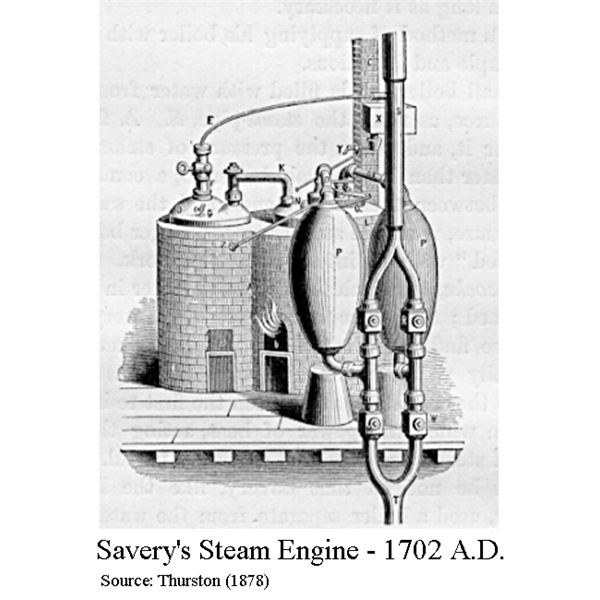
In 1698, Thomas Savery who was a military engineer had created a steam pump device which he nicknamed ''The Miners Friend''.The device consisted of a boiling chamber that routed steam into a second container where a pipe with a non-return valve descended into the water that needed to be removed. Cold water was poured over the container of steam and as the water vapor inside cooled to a liquid state, the resulting vacuum drew up water from below. The sucked-up water was unable to flow back past the non-return valve and was then drained through another pipe. His invention was not used very much by the mining industry and most of his sales were made to private homes for home and gardening needs that wanted to draw out excess water from their homes. The reason for his invention being so unsuccessful was the fact that the steam chamber's heating and cooling had to be managed manually and the engine could only draw up water from a limited depth which meant that if they had to dig a deep mine they would have had to put several engines installed at different levels. 


Though in 1712 Thomas Newcomen who was a blacksmith and his assistant John Calley who was a glass blower created a much more effective steam powered pump system. It was called the Newcomen Engine combined Thomas Savery's separation of the boiler and steam cylinder with Papin's steam-driven Piston. Newcomen's engine was similar to Thomas Savery's it included a steam-filled chamber that was cooled by a quick injection of cold water to create a vacuum-inducing change in atmospheric pressure. This time, however, the force of the vacuum pulled a piston down and pulled a chain that activated a pump on the other end of a suspended beam. When the water in the piston cylinder turned to steam again, it pushed the piston up and a weight on the other side of the beam reset the pump. The Newcomen engine was a major success and was used in hundreds of mines all over Britain and abroad.

But the steam engine of now is of James Watts creation. Watt was in employment at a business near the Glasgow University when one of the universities Newcomen  engines needed repairs. When watt was fixing the steam engine he realised that there was a flaw in the design such as time, steam and fuel were being wasted by having both heating and cooling take place in the piston cylinder.  Watt had solved the problem by adding a separate condenser. 


Howstuffworks, 2013, Howstuffworks. [Online] Available at: <http://science.howstuffworks.com/steam-technology2.htm> [Accessed 20th April 2013]

Friday, 19 April 2013

The Industrial Revolution

The Industrial Revolution had began in England around 1733 with the first cotton mill. The Industrial revolution was a period were important changes happened in agriculture, textile and metal manufacture, transportation, economic policies and the social structure of England. Agriculture had advanced due to the industrial revolution resulting in increased supplies of food and raw materials. Industrial organisation had advanced and new technology had been created due to the advancements resulting in increased production, there was also an increase in profits and efficiency. Though the Industrial Revolution had a big down side to it as well and brought dire consequences to society. Factory Owners needed workers who were unskilled that would accept cheap payment profited by using children and women to run the machines. The majority of the workers had got sick and died due to the toxic fumes, others would die due to being severely injured by the dangerous machines. 


Yale Guide Entry, 2006. Yale-New Haven Teachers Institute. [Online] Available at <http://www.yale.edu/ynhti/curriculum/units/1981/2/81.02.06.x.html#c> 
[Accessed 19th October 2013]

Library Information Page, 2013. IRWeb. [Online] Available at <http://library.thinkquest.org/4132/info.htm>
[Accessed 19th October 2013]

Realism


Realism was a movement that had began in France 1840 and ended in 1880. Realism was a revolt against Romanticism, it was a revolt because of the fact that they had found Romanticism too exaggerated and emotional. Writers and Artists wanted to explore the reality of everyday life. Realism artists and writers had painted and written the world as it is with no imagination or superstition added to it . The artists/writers did not add any of their personal/emotional feelings to the painting/writing, they captured the moment exactly according to the scene. 

A good example of a realist artists work is Jean Francois Millet.

The Gleaners, 1857

This painting is of three peasant women gleaning a field for some pieces of leftover wheat. They are bending their backs which is a very uncomfortable position, in the hopes of finding some scraps of food to eat. This painting shows the harsh reality of poverty and how hard life was for peasants.

Ducksters, 2013, Duckers [Online] Available at <http://www.ducksters.com/history/art/realism.php>
[Accessed 19th April 2013]